

[blog-archive-images]
It’s been another record setting dry and hot summer, not just in England and Wales but across Europe. Ferocious wildfires have devastated huge areas of land. The wheat harvest started two to three weeks earlier than normal and yields, not just for grains, but for everything – vegetables, potatoes, fruit – were down 15 to 50%. And the problems for farmers continue: because of heat and drought grass barely grew, sheep and cattle had to be given what was to be winter feed. Feed prices have risen dramatically, and many farmers will have to sell some animals to be able to feed the rest through the winter months. Planting of winter crops has been delayed, there is so little soil moisture that no seed can germinate. While margins remain low, labour, energy and fertiliser costs have risen enormously. All this takes an emotional toll, too, and quite a few farmers are wondering whether they should get out of farming altogether.
El Niño and hard truths ahead
As long as we are not reducing CO2 emission and continue to burn fossil fuels the climate crisis will get worse. The ‘super’ El Niño conditions which are only just starting to develop are not only increasing heat and drought in some parts of the world and storms and torrential rain in others, they also provide a glimpse into what the ‘weather normal’ will be in 10 years’ time.
Almost every farm in Europe has been affected by the extreme drought and heat this summer, but not all farms were affected equally: overall, organic and regenerative farms did better than conventional ones.
‘Bitter Honey’ and why conventional agriculture is truly unsustainable
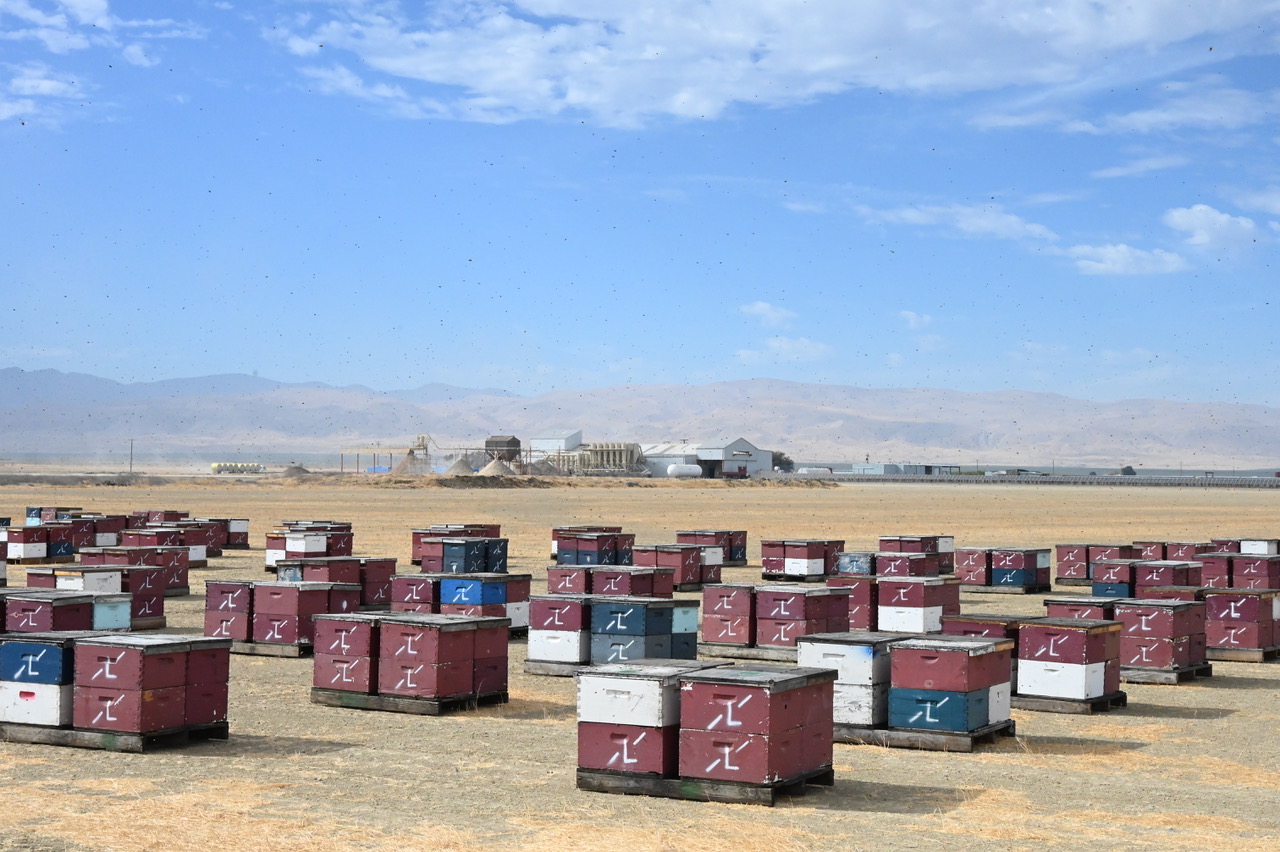
In her book ‘Bitter Honey’[1] author Jennie Durant focusses on bee colonies in the United States, where bees today are mostly kept like any other farm livestock. The main purpose of bees is to provide pollination services in the almond plantations of California and other fruit orchards across the US, honey production is secondary. Year on year, US beekeepers lose between 50 to 70% of their colonies over winter. Durant makes the case that conventional agriculture is the root cause for this development: vast monocultures lack biodiversity and can’t sustain pollinators through the year, pesticides harm all beneficial insects, breeding from a narrow gene pool has left bees more susceptible to pests and diseases, heat and drought reduce the nectar and pollen flowering plants produce, even in summer bee colonies don’t survive without supplemental feed.
Organic and regenerative agriculture: no silver bullet but a way forward
Like the ‘super’ El Niño, ‘Bitter Honey’ gives us a glimpse into where farms and food production are headed under a conventional agricultural system. Farmers who focus on soil fertility and methods such as long crop rotations, cover crops, green manure, composting and reintegrating livestock are more resilient: better able to cope with heat and drought, less likely to suffer crop failures and economically more viable because they need fewer inputs.
In a previous blogpost I called the recently published ‘Living Roots’ by Liz Carlisle and Aubrey Streit Krug a feelgood summer read. In her earlier book, ‘Healing Grounds[2]‘, Carlisle writes about farming systems rooted in indigenous farming systems in the Americas and Asia, which are now being rediscovered as a response to the climate crisis: “These farmers and scientists understood regenerative agriculture not as a menu of discrete, isolated practices from which one could pick and choose and then tally up into a sustainability score. Rather, they saw regenerative agriculture as their ancestors had – a way of life”.
Reconnecting – with food, the land and nature
Organic and regenerative farmers are honing the skills the agrichemical industry told them they did no longer need: attention, observation and awareness. Farmers who value and use these skills are true ‘stewards of the land’ who support the functioning of the farm ecosystem rather than trying to dominate nature with chemical fertilisers and pesticides.
We who eat food, which is all of us, have to tune in and reconnect, too. Rather than expecting any food we want to be available at any time on supermarket shelves, we will have to learn what so many indigenous cultures still adhere to: to recognise food as a gift. Carlisle quotes a Japanese word that sums it all up: ‘Itadakimasu’. “It means I gratefully accept this food, but also, acknowledge the laborers who grew it, I acknowledge the trees, I acknowledge the farm, thank you to everybody who brought it to me.”
Marianne Landzettel is a journalist and author writing and blogging about food, farming and agricultural policies in the UK, the US, continental Europe and South Asia. She worked for the BBC World Service and German Public Radio for close to 30 years. Follow her on X at @M_Landzettel and Instagram @m.landzettel . Image used with kind consent of @M.Kunz
The Slow Food blog welcomes contributions on the topics of Food, Farming and Agriculture. The contents may not entirely match the views of Slow Food, but reflect the journeys of the authors. To write for us please click here
[1] Jennie Durant: Bitter Honey, Princeton University Press 2026
[2] Liz Carlisle: Healing Grounds, Island Press 2022, paperback edition September 2026


