


[blog-archive-images]
The greenhouse is her first thought when she wakes up. Will the plants be alright? What needs doing today. What might be ready for harvest? 34-year old Sulma is an inmate in the women’s section of a high security prison in Potosí[1], a city high up in the mountains of southwestern Bolivia, and currently she leads the prison greenhouse team.
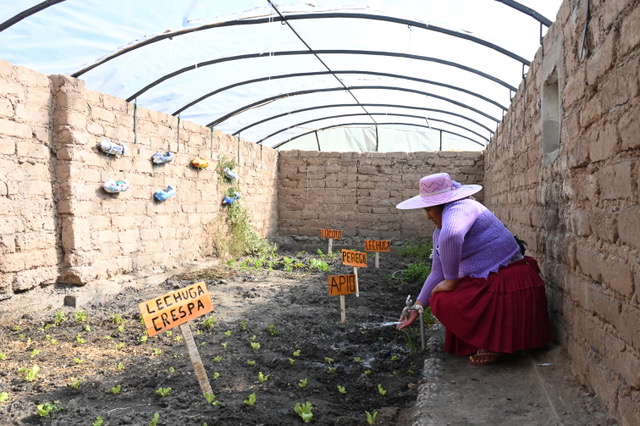
To show the visitors around, Sulma has donned her best, most colourful clothes and wears a lilac plastic hat.
The greenhouse is a fairly basic structure: metal struts for the roof are anchored in mud walls and covered by plastic sheeting. On one side, a small walkway is separated from the growing area by a long row of soft drink bottles half-buried in the ground to make a border. On the opposite wall, three litre bottles have been cut open and filled with soil for growing hanging plants.
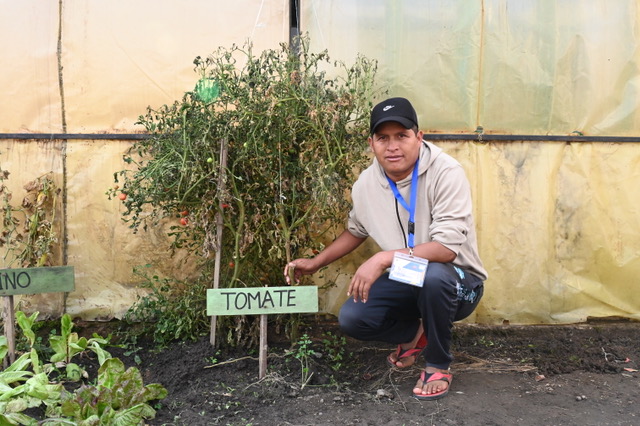
The women grow several types of salad, mint, peas, watermelons, garlic and parsley. Tomatoes are their most high value crop which are a particular favourite among the women who use it to make the prison diet a little more palatable.
The greenhouse in the women’s section is one of two in this prison complex with around 1,000 prisoners. The greenhouse in the much larger men’s section was the first to be built. Overall, there are now six greenhouses in four of Bolivia’s 70 prisons.
It all started with tears and a drawing
In Bolivia, AVP, the Alternatives to Violence Project, an NGO, works in many of the country’s prisons. They run workshops in which participants – male and female prisoners but also interested prison staff – learn to communicate better, not to resort to violence and work as a team. In 2020, Magaly Quispe Yujra, the head of AVP Bolivia, led an exercise during which participants had to write about or draw what they missed most from their life before prison. One member of that group was Guillermo, a farmer who serves a 30 year sentence for murder. He had come home to find a neighbour sexually assaulting his daughter. The attempt to fight the neighbour off and protect his daughter ended with the death of the neighbour. What Guillermo missed most in prison was growing crops. He is illiterate, so he drew his farm and his fields, he didn’t have a lot of land, but he had grown potatoes, fava beans, wheat and a little corn. “When he explained his drawing to the rest of the group he just said ‘I was used to work the land every day’, and then he just cried and cried”, says Magaly.
Bringing the field into the prison
She and her colleagues at AVP started thinking. During their visits they saw how bad the prisoners’ diets were. There was little else apart from rice, pasta and fried foods, and the team was constantly asked to bring medication to alleviate stomach pain. “What they really needed were fresh vegetables and we suddenly thought: maybe we can bring the soil inside”, says Magaly. In spring of 2021 they sent a funding application to Quaker Bolivia Link, a Quaker NGO. It was approved a few months later. Then things moved quickly: the national and the Potosi prison authorities gave permission for the project, an NGO in La Paz built the metal structures to support the greenhouse roof, which was then assembled inside the prison. AVP bought seeds, had two truckloads of soil delivered, and in December of 2021 (early summer in Bolivia) the greenhouse was ready for the first vegetable seeds to be sown.
Hoping for more
“We desperately need more space to grow”, says the team leader of the greenhouse in the men’s section more than once. At present, lettuce and celery are the most popular crops. Some lettuce has been left to bolt, the team will save the seeds. On the side of the greenhouse grows corn, out front spare soil has been spread into a mini field where the team hopes to grow potatoes.
Places on the greenhouse team are sought after, there is a long waiting list for one of the five six months slots. Only one person will stay for 12 months as team leader and to train the next group.
The Bolivian prison authorities love the greenhouse projects and want AVP to build more. The same now goes for the police. “It took a lot of convincing”, says Magaly, “but today they are happy to see us. There is less aggression among the prisoners. And a policewoman told me: you are really helping us because of the medical plants that can be grown in the greenhouses. We have to deal with far fewer requests for medication from outside the prison”.
The prison in Uyuni, a town 200km southwest of Potosí recently sent an official request letter to AVP, signed by the prison authorities and the prisoner representatives; in Potosí the women want to extend the existing greenhouse, the men are hoping for a second one, La Paz has seven prisons and all are hoping to get greenhouses eventually, though in some there won’t be enough space: one La Paz prison was built for 200 inmates and today houses 5,000…. But there are enough prisons with sufficient space to build greenhouses – if only there was the money for it.
[1] The city of Potosí lies at the foot of Cerro Rico, the ‘Rich Mountain’. In 1545, huge silver deposits were discovered, the mountain seemed to be made of silver. For several centuries, the Spanish colonial masters forced thousands of indigenous people to mine the silver which was then made into coins at the mint in Potosí. Silver from Potosí funded the Spanish colonial empire and the silver coins, the ‘pieces of eight’, mark the beginning of global trade. (For more see: https://www.bbc.co.uk/programmes/articles/4zCD5RBzrC6dXKcX8hSFsrR/episode-transcript-episode-80-pieces-of-eight)
At over 4,000m, moving is tiring and breathing can be hard. Mines are always dangerous places, but working conditions in the Cerro Rico mines were horrendous, the survival rate of the miners was so low that the Spanish resorted to bringing African slaves to Potosí. Over the centuries, an estimated eight million indigenous people and African slaves died in Potosí’s silver operation.
Marianne Landzettel is a journalist and author writing and blogging about food, farming and agricultural policies in the UK, the US, continental Europe and South Asia. She worked for the BBC World Service and German Public Radio for close to 30 years. Follow her on X at @M_Landzettel and Instagram @m.landzettel . Image used with kind consent of @M.Kunz
The Slow Food blog welcomes contributions on the topics of Food, Farming and Agriculture. The contents may not entirely match the views of Slow Food, but reflect the journeys of the authors. To write for us please click here


