

[blog-archive-images]
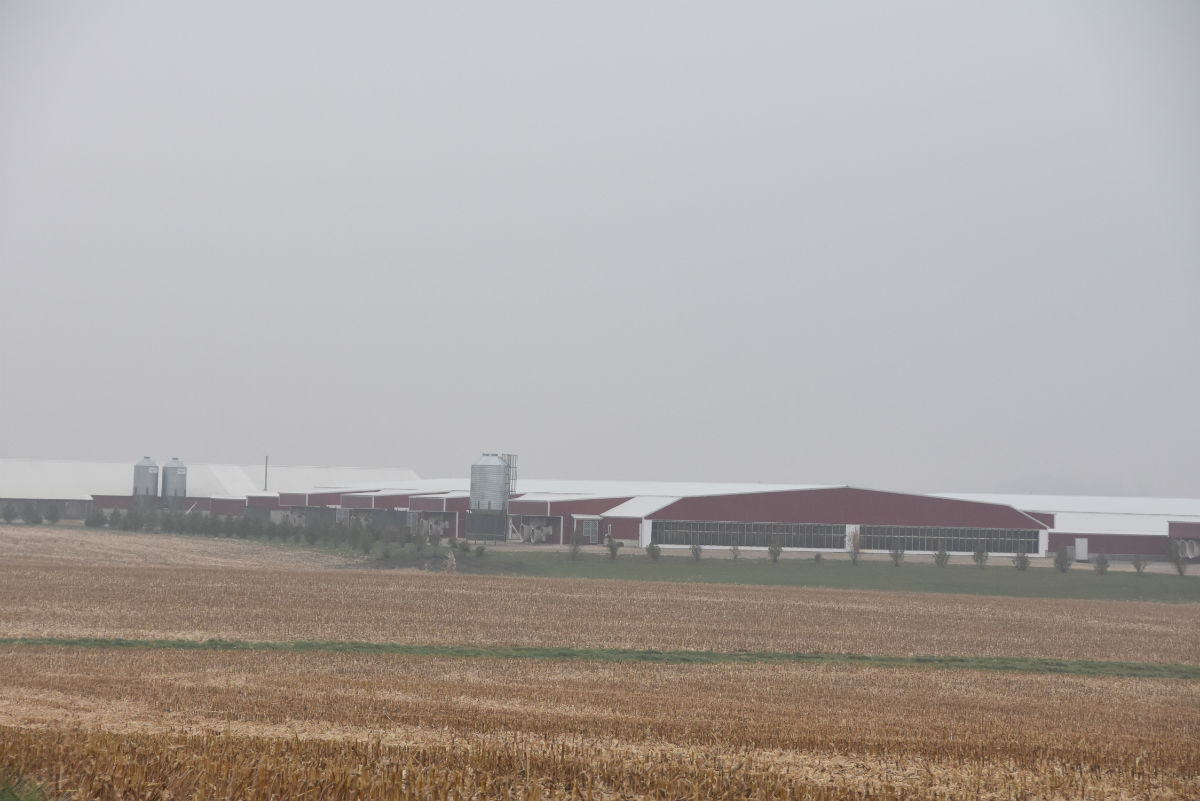
Sonja Trom Eayrs grew up on the family farm in Dodge County in southern Minnesota. She studied law and is a practicing family lawyer in Minneapolis – writing a book wasn’t part of the plan. But in the early aughts life in Dodge County started to change rapidly. More and more planning applications were made for ever bigger intensive swine facilities with thousands of hogs. Life in the immediate vicinity of such a CAFO (concentrated animal feeding operation) is often unbearable: the stink is so intense that you cannot open the windows in your house, let alone sit in your garden or hang out the washing. And it’s not just a very bad smell, the fumes contain large amounts of ammonia which is a serious health risk. The concentrated manure from CAFOS will be sprayed onto or injected into fields and often pollutes water courses and, depending on the geology of the area, drinking water sources.
In her book, Trom Eayrs describes her family’s legal fight against the construction of several such CAFOs next to the farm. In the end, they lost the battle in court, in a three mile radius, the farm is now surrounded by no fewer than 12 intensive hog facilities. But as painful as those years were, Trom Eayrs also gained a deep insight into what ‘vertical integration’ in the meat industry means, and how this system destroys independent family farms and with it the rural economy.
Recruitment at the grain elevator
Four meat processors dominate the US market. They control the supply chain from ‘squeal to meal’, from the barn where the pigs are raised to the packed meat on the supermarket shelf. Trom Eayrs describes how agents approach young, inexperienced farmers at the local grain elevator with a proposal that sounds too good to refuse: become a contract grower, piglets and feed will be delivered and at the end of the month you’ll get a pay cheque. Of course, the farmer will have to invest into barns and infrastructure, but bank loans can be arranged. As a lawyer, Trom Eayrs got to see an actual integrator-grower contract. “One can’t but admire the thoroughness”, she writes. The grower receives no benefits such as healthcare or pension payments, instead he is financially responsible for anything that could possibly go wrong. The contract Trom Eayrs saw left the grower at the end of an average month and the deduction of labour, energy and water costs with an income of $41, that’s £31.19.
Legal tricks, threats and bribes
In the US today, making a living as a mixed family farm with a small pig unit is near impossible. There are hardly any independent slaughter facilities left, and as in the UK, most abattoirs do not accept small numbers of animals for slaughter. In the US, most process only the pigs from contract growers.
Opposing plans for a CAFO is not just difficult, it can be outright dangerous. Trom Eayrs describes how e-mail alerts have contract growers travel long distances to fill every seat in a community hall when a planning meeting is scheduled, so that residents have no chance to voice concerns. On the rare occasion that a planning permission is rejected, highly paid lawyers are at hand to appeal and to fight the decision in court. But usually ag corporations and organisations like the Corn Growers Association, the Soybean Association or the National Farm Bureau have prepared the ground with lots of PR and money: they make sure that planning committees and boards are staffed with people who don’t fret over issues such as air and water pollution. Trom Eayrs describes one case where committee members received lucrative contracts for the distribution of manure right before they had to take a decision. And opposing planning applications has real life and personal consequences. Trom Eayrs tells of residents who signed a petition and had their names and addresses made public. Intimidation is rife: dead animals on the doorstep, a sudden fire in the garden, trucks that threaten to force one’s car off the road on a narrow country lane, even death threats.
It can’t happen here?
It can and it does. The alliance for better food and farming, Sustain, has just published a map of UK megafarm operators and reviewed recent planning applications for large poultry and pig units (https://www.sustainweb.org/news/oct25-intensive-livestock-ghg-emissions/).
“The findings indicate persistent, systemic non-compliance with rules that require the disclosure of environmental information, leaving planning decisions vulnerable to legal challenge. (…) If approved, at least an estimated 128,000 additional pigs and 37 million chickens would be raised in megafarms each year, while the environmental damage remains hidden from the public and decision makers”, says the Sustain report. And Sustain climate campaigner Lily O’Mara concludes: “It’s no wonder so many farmers are putting up intensive chicken and pig sheds. They’re being squeezed by powerful food corporations, hit by climate change, and given next to no government support to grow healthy, sustainable food”.
We are not powerless!
Vertical integration and intensive (animal) agriculture not only threaten small and medium sized family farms. Both have a detrimental effect on the rural economy as a whole. Trom Eayrs cites a 2022 Food & Waterwatch study. It compared rural counties in Iowa with high CAFO density with those that still had a higher number of small farms. It found that between 1982 and 2017 personal income on average rose by 41%, but in counties with a high density of pig CAFOs it fell by 8%. Rural business over all declined by 2%, but in counties with very intensive pig rearing it fell by 33%.
It’s not really a surprise: where producers earn next to nothing they can’t buy stuff or go out for a meal, which in turn negatively affects businesses in the area.
Even if we live in urban areas, we are not powerless and can effect change, says Trom Eayrs. Her advice: “Work together to create strong local markets. Invest in your local farmers and farming communities. This is a fight of community vs corporation. Join together as a community. Which means: the local restaurants support the farmers, the local school supports the farmers… That’s how you build a strong local network and build your safety net at the local level. And get informed, stay informed and educate others”. Reading Dodge County INC. is a good start.
Sonja Trom Eayrs
Dodge County, INC.: Big Ag and the Undoing of Rural America
Bison Books, University of Nebraska Press
£19.57 (Kindle Edition £14.97)
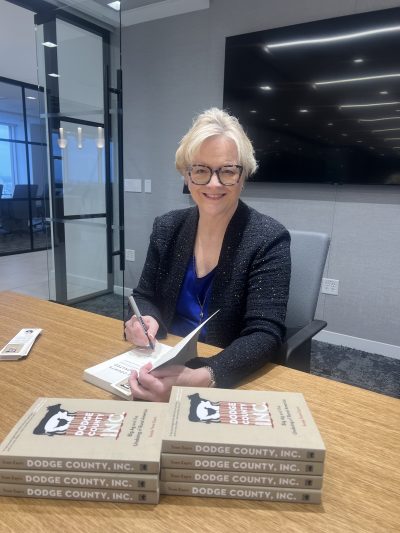
Marianne Landzettel is a journalist and author writing and blogging about food, farming and agricultural policies in the UK, the US, continental Europe and South Asia. She worked for the BBC World Service and German Public Radio for close to 30 years. Follow her on X at @M_Landzettel Image used with kind consent of @M.Kunz
The Slow Food blog welcomes contributions on the topics of Food, Farming and Agriculture. The contents may not entirely match the views of Slow Food, but reflect the journeys of the authors. To write for us please click here


