

[blog-archive-images]
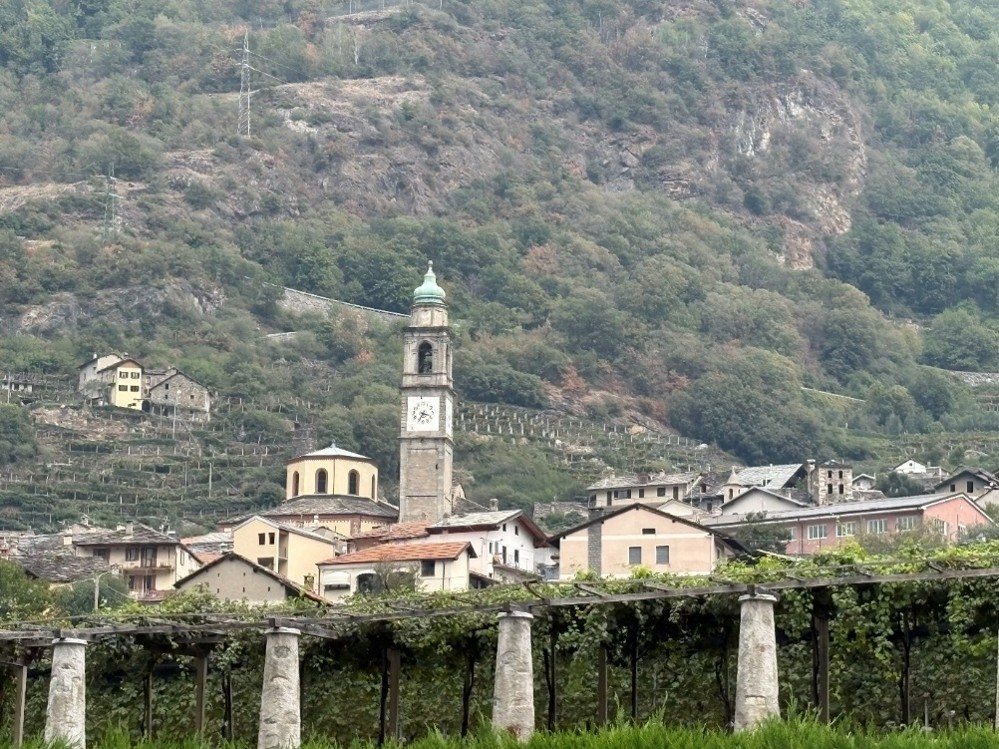
Leaving the rolling Langhe hills and their famous Barolo appellations, we head north past the city of Turin. As the mountains come into closer view, the traffic thins out and the road is flanked by increasingly steep mountains. We are approaching the most northerly wine appellation in Piedmont, the tiny Carema DOC, in the Canavese. Carema is a village with a population of around 700 people and a landscape more resembling a mountain region than the more familiar Nebbiolo vinegrowing terrain. Here we are at the edge of the Alps, bordering Aosta, famous for the ski resorts of Courmayeur and Cervinia and views of Mont Blanc and the Matterhorn.
Carema DOC
Wine has played an important role in Carema since the early 20th century. Carema was granted DOC status in 1960, around the same time as some of its more famous Langhe cousins. Unlike the Langhe, Carema DOC is a very small winegrowing area of only 18 hectares compared with hundreds of hectares in Barbaresco and more than 2,000 hectares in Barolo. It requires labour intensive viticulture to cultivate its steep terrain and produce its renowned Nebbiolo based wines compared to the generally more accessible vineyard slopes of the Langhe Nebbiolo region.
Heroic Viticulture
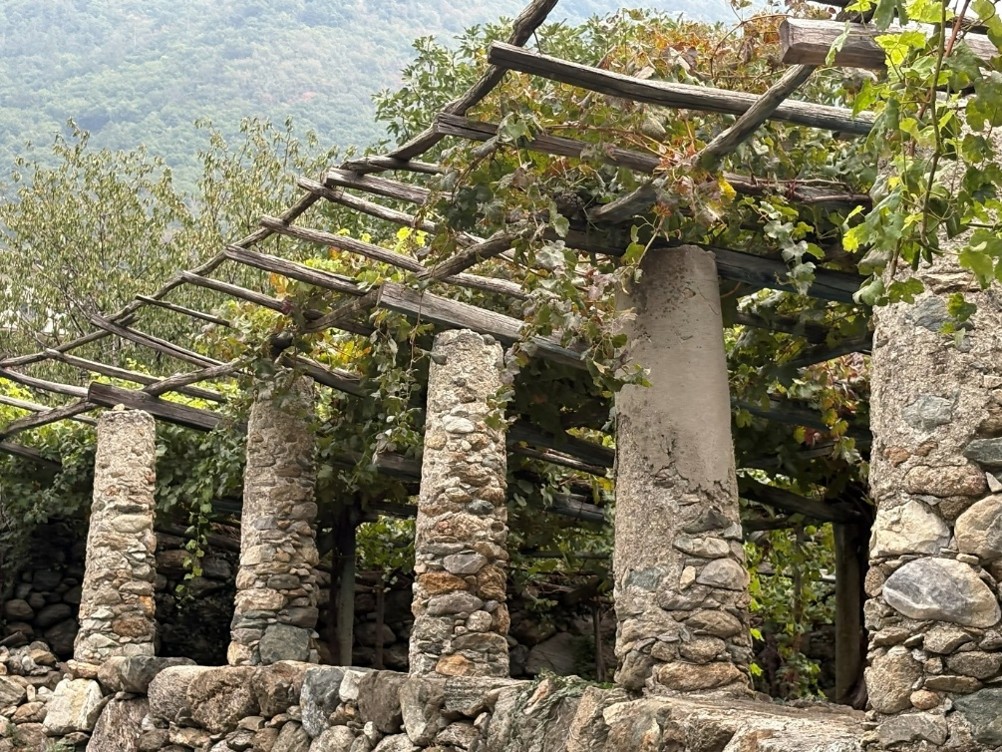
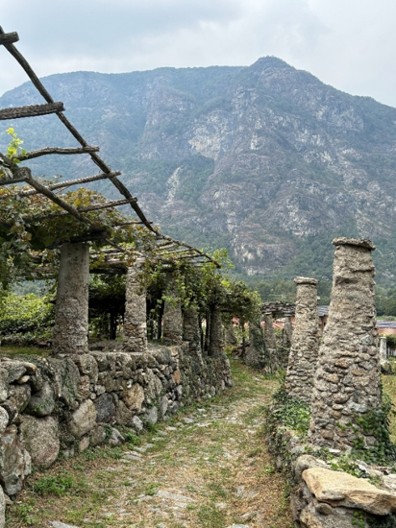
To make the land suitable for growing vines, the locals built stone terraces into the steep mountainside; many rise high above the town from 300-600m above sea level. Vines grow along horizontal chestnut arms in a traditional pergola structure (locally called “topia” or “tupiun”), supported by cone shaped stone pillars (or “pilun”) which sit on the terraces. Willow trees grow nearby and their shoots are used to tie the vine canes to the pergolas. Everything here is done manually, from pruning, canopy management, harvest and even taking the grapes back down to the winery.
Image 2: Close up of Carema’s traditional pergola system at Cantina Carema
Carema’s altitude and its northerly location means it experiences marked differences between daytime and nighttime temperatures. The stone terraces help mitigate these fluctuations, absorbing heat from the sun during the day and radiating warmth back to the vines at night which helps the grapes ripen. Carema’s geological history and the shape of its landscape also play their part. The soils here are the result of glacial activity and the valley is surrounded by a morainic amphitheatre which creates a sunny basin which also helps the grapes ripen.
The Carema Nebbiolo Producers Cooperative is part of the Slow Food Presidium
The people who work the land and produce the wine are very small growers. Their aim is to uphold the traditional practices of their grandparents in a way that is consistent with the character of Carema’s landscape. The Cooperative describes their commitment to tradition as having a practical purpose: keeping this distinctive form of mountain viticulture alive for future generations and recovering abandoned vineyards. The Carema Slow Food Presidium plays a vital role in safeguarding the wine as well as the landscape and the local heritage skills.
Cantina Carema (or the “Cantina Produttori Nebbiolo di Carema”) is the smallest of the three social cooperatives in the Canavese area. It was originally founded with 18 members and now has 60 members including fathers, sons, and grandchildren. They devote their spare time to tending micro plots in the vineyards, delivering grapes to the winery and dedicating their time to helping with bottling, harvest, and other seasonal work.
Image 3: Mountain backdrop
Wines produced in Carema DOC
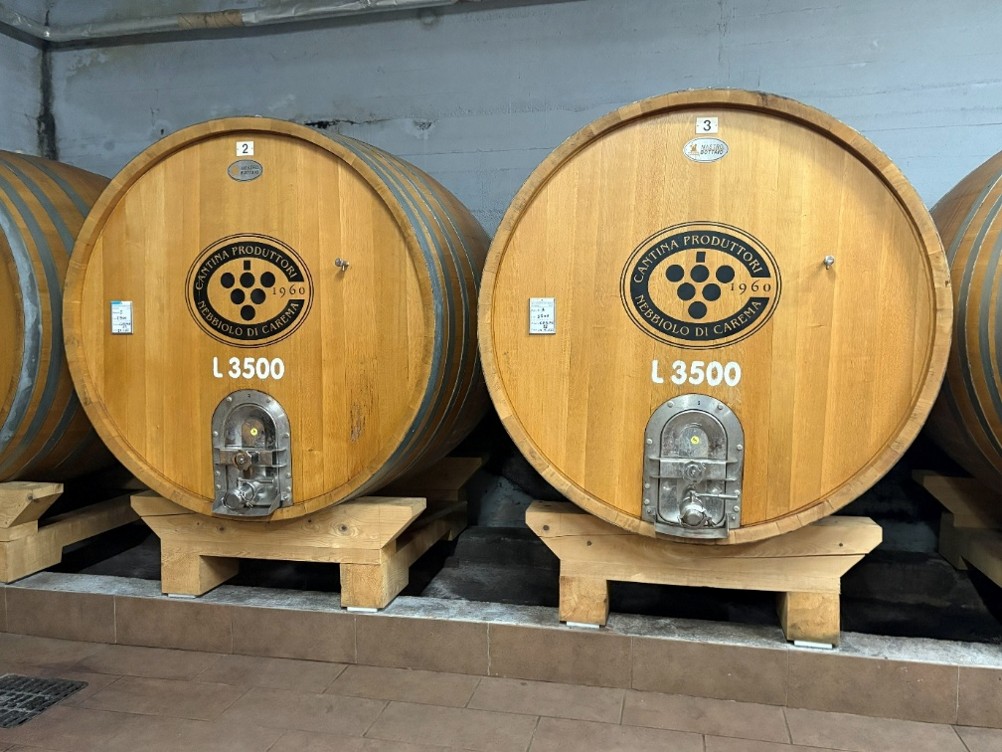
Under the Carema DOC appellation rules red and longer aged “riserva” wines can be produced with a minimum of 85% Nebbiolo. In practice, Cantina Carema makes Carema DOC and Carema Riserva DOC using only Nebbiolo in common with wines produced in Barolo and Barbaresco where 100% Nebbiolo is stipulated. Their wines spend some time ageing in oak or chestnut barrels and the Riserva is made from 20% of the best lots from each vintage and is not produced every year. Other wines that the cooperative produces such as traditional method sparkling, rose, white and red wines are outside the Carema DOC appellation.
Image 4: Some of the newer 3,500L barrels
Nebbiolo based wines in Carema are different in style from those in the Langhe. The wines are pale garnet in colour, the high altitude can lower the alcohol by a degree or so and the wines are lighter, fresher and more delicately perfumed with more floral and mineral notes in contrast to the more muscular style of Nebbiolo.
The cooperative’s wines have earned high recognition. As well as appearing in the Slow Wine Guide, the winery announced in October 2026 that its Carema DOC 2022 achieved Vitae 2027’s highest excellence category, the annual Italian wine guide published by AIS, (“Associazione Italiana Sommelier”), the Italian Sommelier Association.
The Carema Riserva DOC has been awarded “Three Glasses” (‘Tre Bicchieri”), the highest rating awarded by the influential Italian wine guide Gambero Rosso, for at least five vintages, most recently for 2021. The 2021 vintage featured in the latest winners’ list published in October 2026 and will be included in the “Gambero Rosso Tre Bicchieri 2027” Guide. It also won gold at CERVIM’s “Mondial des Vins Extrêmes”, a competition dedicated to wines from heroic viticulture, announced in September 2026.
Pairing presidium food and wine
In a region like Piedmonte we must mention how well the local food goes with the region’s wines. Piedmont’s wide range of toma cheeses offer a natural starting point for Carema DOC and Carema Riserva DOC. We suggest a moderately matured mountain toma for the DOC and a fuller-flavoured version for the Riserva DOC. Should you find yourself in the Canavese region of Piedmont we suggest a specialist alternative cheese, a Macagn from nearby Biellese and Valsesia, a raw-milk mountain cheese made by Slow Food Presidium producers. Of course Carema DOC wine also goes well with risotto, cured and grilled meats, whilst richer game dishes are particularly suited to the Riserva. If you visit in winter do try Tofeja, a dish of beans, pork and herbs, traditionally eaten during Carnival season in February or early March. Also look out for Piattella canavesana beans, part of the Cortereggio Slow Food Presidium if you are interested in making make these regional specialities at home.
Next time you’re in Piedmont do consider an excursion north from Turin to visit the picturesque and less visited Canavese region, and try the excellent Nebbiolo of Carema DOC.
|
Cantina dei Produttori Nebbiolo di Carema Via Nazionale, 32 Tel: +39 0125 81 11 60 Email: cantinaproduttori@caremadoc.it Web: www.caremadoc.it/ Instagram: @cantinacarema |
(c) Lynn Morgan.
The Slow Food blog welcomes contributions on the topics of Food, Farming and Agriculture. The contents may not entirely match the views of Slow Food, but reflect the journeys of the authors. To write for us please click here


