


[blog-archive-images]
It’s the first Saturday in October just before 9.30 am. A small queue has formed, about a dozen people – couples, a family with young kids – are patiently waiting in the sunshine, enjoying the scent of freshly baked bread and cinnamon buns wafting out from the doors of the bakery, where Rosie is just arranging the last trays with pork pies and apple turnovers. Next door Milly is sorting sausages and cuts of meat, while several customers are waiting to pick up meat boxes and preordered baked goods. By midday the shelves will be empty and Milly and Rosie can close shop. All visitors to Gothelney Farm[1] will now see are the heavy wooden doors painted an elegant grey and the long brick wall that leads to the main courtyard. The surrounding buildings are ancient and all have been beautifully restored – Gothelney Farm is mentioned in the Domesday Book.
Today, Gothelney is a modern farm business that not only honours and respects tradition, third generation farmer Fred Price sees the farm as an ecosystem linked to and into other ecosystems. “It’s all about relationships and about balance”, he says.
“This is not me”
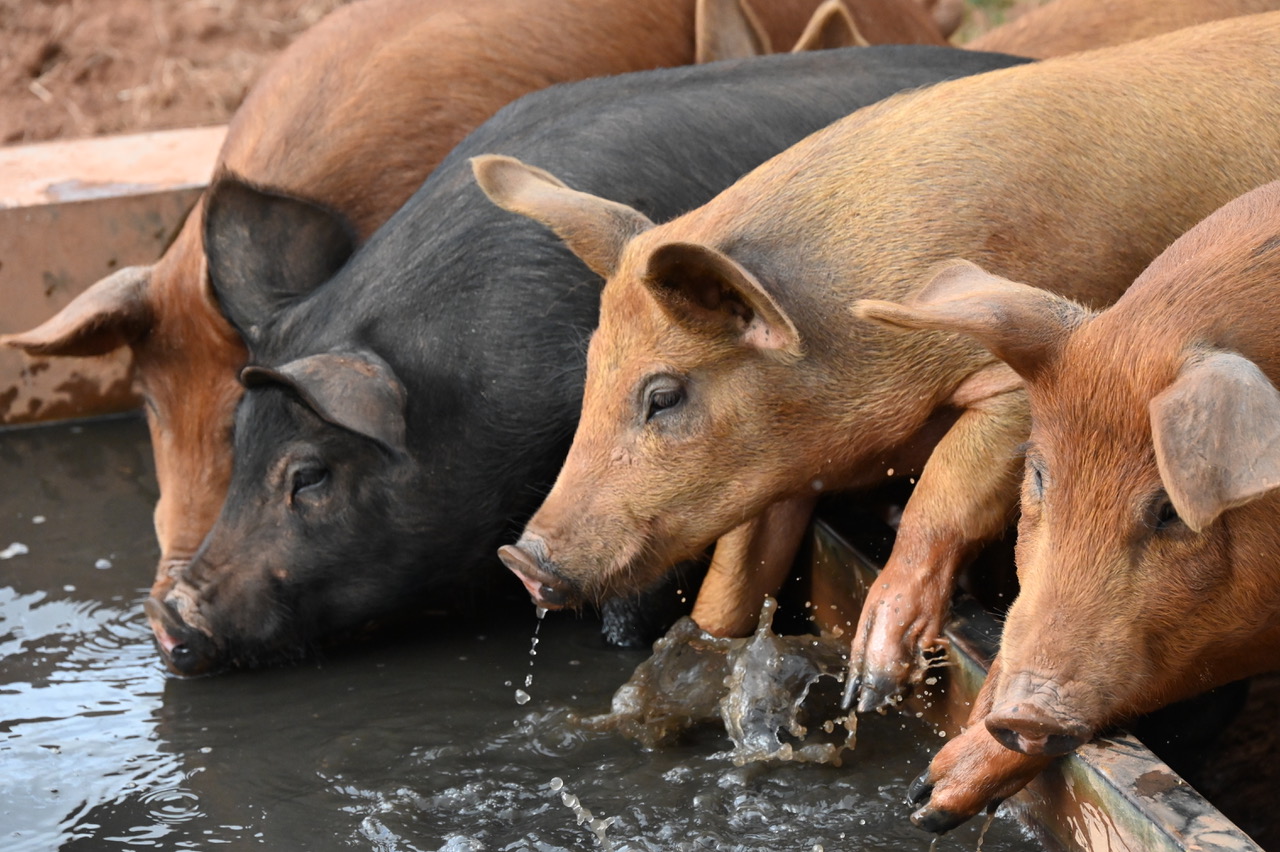
There is the farming side. When Fred took over the management in 2007 the farm was run conventionally, grains were produced for the commodity market with the help of chemical fertiliser and herbicides. The pigs were kept in confinement, the soy rich feed was bought in. The 2012/13 harvest was bad and the resulting financial pressures made Fred finally act on the unease he’d felt all along: he did not want to produce food with lots of chemicals, he wanted the pigs to have a good outdoor pig lifestyle, and why buy soy from abroad when he could grow all their feed on farm as part of a crop rotation that benefits the soil, biodiversity and provides a habitat for lots of animals and insects?
It’s all about relationships
As if switching to regenerative agriculture wasn’t hard enough, once you don’t produce for the commodity market anymore, you have to find new buyers. “It’s all about relationships”, says Fred, the relationship within the family, with friends and neighbours, and the supply network to craftsmen and -women and customers – an alternative agroecological food system in the making.
Fred’s brother-in-law Dan is a butcher, and together they built a butchery on the premisses where Dan butchers three of the farm’s pigs every week. The pigs are born and raised outdoors, the abattoir is a 20 minute drive away. Maybe one day Dan will also slaughter on farm, who knows…
Population wheat
The grain, too, has pedigree. Fred grows ‘population wheat’. In the early 2000s, wheat breeder Martin Wolfe and his team hand-pollinated 20 wheat varieties to cross them with each other. The progeny of the resulting more than 190 crosses were grown together to create a diverse population of wheat plants with considerable genetic diversity. More diversity within a population means increased resilience, the group of plants overall are better able to respond to changing and changeable conditions. YQ turned out to be the most promising of the ‘population wheats’ Martin Wolfe and his team created, Y stands for yield and Q for quality. By 2015, YQ became available for commercial use. Fred has been working in a similar manner
selecting and crossing varieties, the resulting composite cross population suit the particular soil and climatic conditions on the farm
Milled on farm
Like wine, wheat has ‘terroir’, and as no two growing seasons are the same, the baking properties of the wheat such as gluten and protein levels vary, too. It takes a craft baker like Rosie to use population wheat to create breads, buns and pastries that look perfect and bring out the unique taste of the grain. The small mill at the back of the bakery produces 50 tons of flour a year, Fred hopes to expand, so that all the grain grown on the farm can also be milled on the farm.
The customers love both, the baked goods and the meat products. The shop on the farm is only open on the mornings of every first Saturday of the month, but there is also a meat box which can be ordered online, produce is regularly sold at the farmers’ market in Bristol and the farm sells to a number of local restaurants and shops.
Price is dreaming of a self-service farm shop where customers would have round the clock access to baked goods, flour, meat, eggs and milk…
Work-life balance
Farming should not be a balancing act that leaves you no time for family and life beyond the farm gate. In the Price household Sundays are family time.
The transition to organic is almost complete. “Our farm is organic now, we don’t have to change anything, but the organic certification will be visible proof of who we are to the rest of the world”, says Price.
For the first year he is now farming in close co-operation with his friend and neighbour Daniel. Combined they have 600 acres of land, half of which will be arable land farmed by Fred, the other half will be sown with herbal lays which Daniel and his dad will graze with around 1,000 ewes. After three years they will swap, where the herbal lays were, grains will grow, and vice versa. A perfect set up for plants, animals, the soil, biodiversity, yields, quality – and time. When things are in balance farming isn’t a balancing act.
[1] https://www.gothelneyfarmer.co.uk/
Marianne Landzettel is a journalist and author writing and blogging about food, farming and agricultural policies in the UK, the US, continental Europe and South Asia. She worked for the BBC World Service and German Public Radio for close to 30 years. Follow her on X at @M_Landzettel and Instagram @m.landzettel . Image used with kind consent of @M.Kunz
The Slow Food blog welcomes contributions on the topics of Food, Farming and Agriculture. The contents may not entirely match the views of Slow Food, but reflect the journeys of the authors. To write for us please click here


