

[blog-archive-images]
These days, reading about agriculture, food production and food security can feel like doom scrolling. Between the climate crisis, farm bankruptcies and political turmoil, engaging with the countryside only while reading a Jilly Cooper novel may be tempting. Though for once there is a choice of feelgood non-fiction:
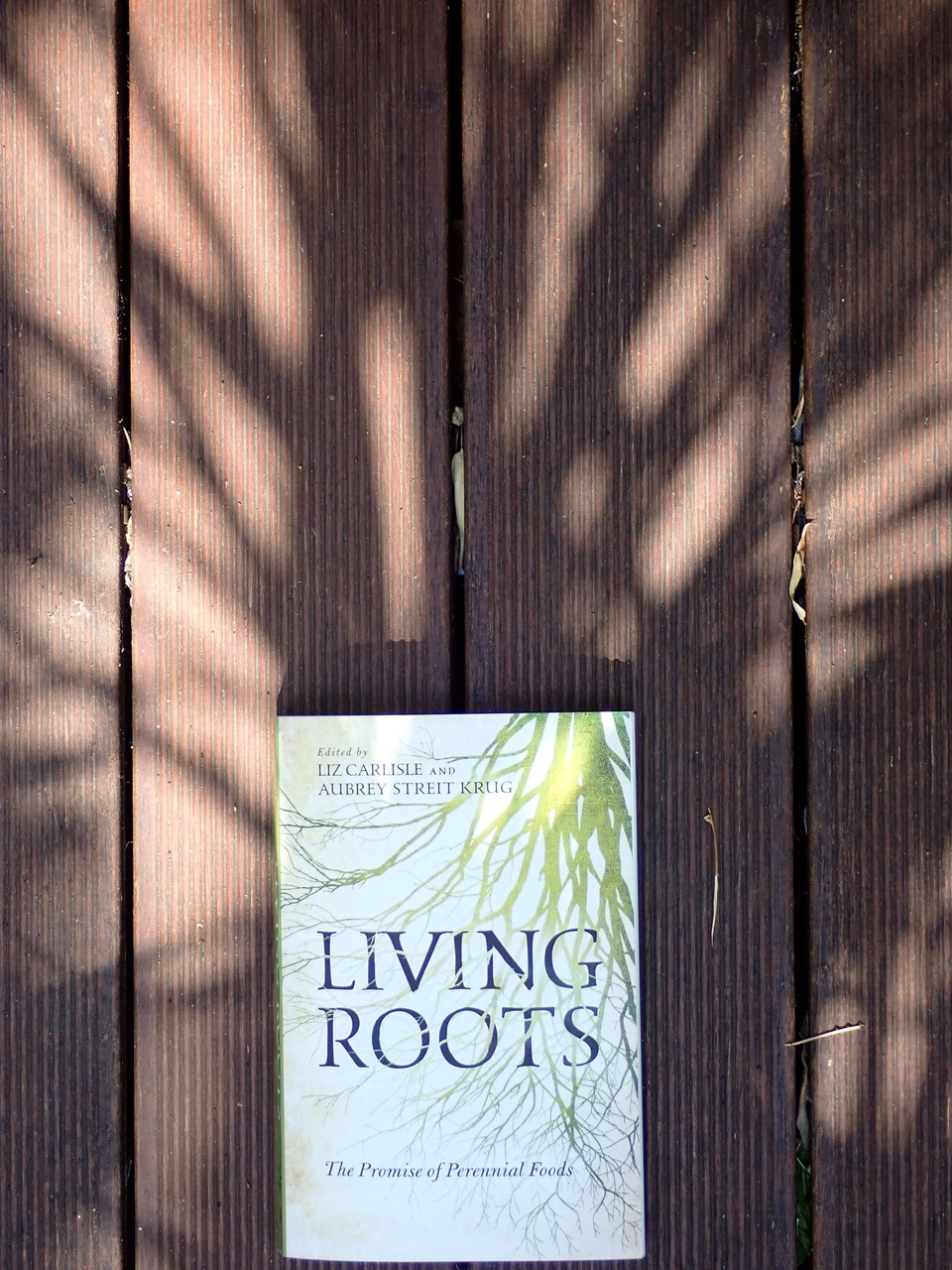
Living Roots – The Promise of Perennial Food[1]
The editors, Liz Carlisle and Aubrey Streit Krug have done a fantastic job assembling a motley crew of writers – farmers, scientists, food writers, indigenous folk, urban gardeners, land stewardship managers, poets… and combinations of the above, to write short essays. The authors tell you who they are, what they do and why they do it in no more than eight pages.
Liz Carlisle who now teaches in California at UC Santa Barbara has always had a knack for finding good news stories – such as the Montana farmers who defied Big Ag and started an organic farm-to-table food chain she portrayed in ‘Lentil Underground’.
Why perennials?
Because they are vital for the planet and we are in the middle of the climate crisis. Perennials sequester much more carbon underground than annuals and many are edible or they shape a habitat in which other foods can be produced. As one of the authors puts it: “I remember an old postcard: ‘Gravity, it’s not just a good idea, it’s the law!’ It took me close to half my life to realize that perennials were in fact the law of the land.”
The book has three sections, focusing on forests, grassland and grain. Trees and deep rooted perennial grasses planted in contour strips transform a steep slope into productive land on a New York farm. On a Wisconsin farm 1,500 chicken live ‘free range’ in a forest. Birds, bats and shade trees are vital for pest control on small scale coffee farms and, who knew, there used to be an oak savanna in the Midwest which is now dominated by maize and soy monocultures. “Rather than taking land out of agriculture in order to restore its ecological health, we need to restore ecology via agriculture. True to the deep history of humans in savannas, farmers were the keystone species to make that happen”.
Indigenous wisdom
“Knowledge from the past to inform the future”, says another author. There are the techniques we are slowly starting to relearn such as using fire as a tool to promote growth and sustain the life of plants, animals and people. Or to understand ‘the land as text’ where places and place names connect to “stories, songs, and rituals” – something that isn’t just true for native Americans. “Many, if not most, fields across the country have names, some of which go back hundreds of years”, writes the farmer and long time NFU President Minette Batters in her book “Harvest[2]“: ‘Cliff Extension’, ‘Barford Down’, ‘Bats Croft Wood’ – the names hold emotional connections and knowledge on her farm in Wiltshire.
Universal knowledge
Much of the US used to be covered by prairies, and grasses are what grows best in much of Britain, too. Insights from working with prairie strips and grazing therefore are directly transferable to what can be done and is already practiced here in the UK. “The template for ecologically sound, profitable, regenerative agriculture, I realized, was a well-managed pasture”, writes one contributor. Cattle have an important role to play in American agriculture, “the work of restoring the ecological benefits of perennial grassland to our agroecosystems”. The same holds true for the UK, for continental Europe, for grasslands around the globe.
I read Living Roots cover to cover over two days. But you can just as easily pick this book up and dive into the essay that happens to take your fancy. Each one will take you to a good place where there is hope for food, for us and the plan
[1] Liz Carlisle and Aubrey Streit Krug: Living Roots. The Promise of Perennial Foods, Island Press 2026
[2] Minette Batters: Harvest, Ebury Press 2026
Marianne Landzettel is a journalist and author writing and blogging about food, farming and agricultural policies in the UK, the US, continental Europe and South Asia. She worked for the BBC World Service and German Public Radio for close to 30 years. Follow her on X at @M_Landzettel and Instagram @m.landzettel . Image used with kind consent of @M.Kunz
The Slow Food blog welcomes contributions on the topics of Food, Farming and Agriculture. The contents may not entirely match the views of Slow Food, but reflect the journeys of the authors. To write for us please click here


