


[blog-archive-images]
Did you ever wonder what happened next…?
At the end of March, the Guardian reported how here in Britain, Home Office’s Ice (Immigration compliance enforcement) officials raid businesses in search of undocumented workers[1]. British Ice raids are not as brutal and potentially lethal as ICE (Immigration and Customs Enforcement) crack downs in the US under President Trump, but for anyone involved, documented or undocumented, it is a scary experience nevertheless. And incidents, in particular in restaurants and other food businesses, are on the rise: “In 2025, Ice officers carried out 12,791 illegal-working raids and made 8,971 arrests. However, the Home Office’s figures show that only a quarter of those arrested (2,251) were detained and 12% (1,087) left the UK, either by force or voluntarily”, writes the Guardian.
Have you ever wondered what happened next…?
What do those undocumented workers do when they get back to their country of origin, either because they are deported or choose to leave voluntarily? During a visit to Mexico I had the chance to meet people who had lived as undocumented workers in the US and find out a little bit more what happened next…
Fine Dining in Cholula
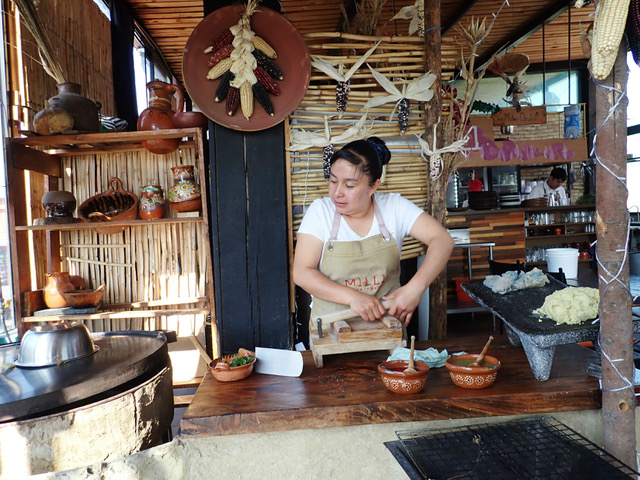
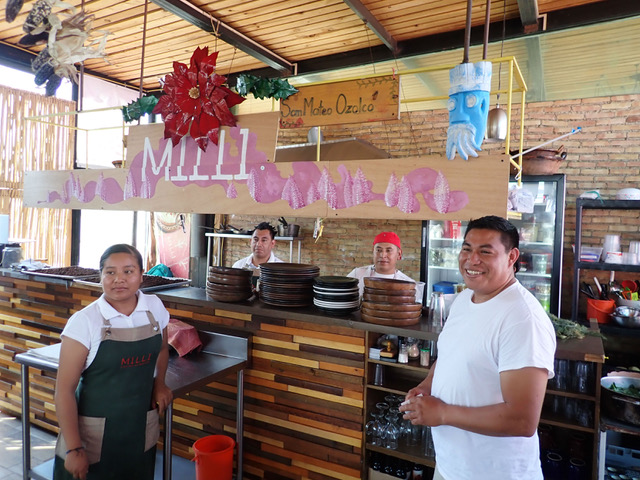
Tucked away on the first floor of a small shopping mall, the restaurant is not easy to find. But not just foodies from Mexico City know about Milli, “since we opened in 2016, we had two groups from Slow Food Italy visit us”, founder, owner and chef Leobardo Téllez Pérez tells me.
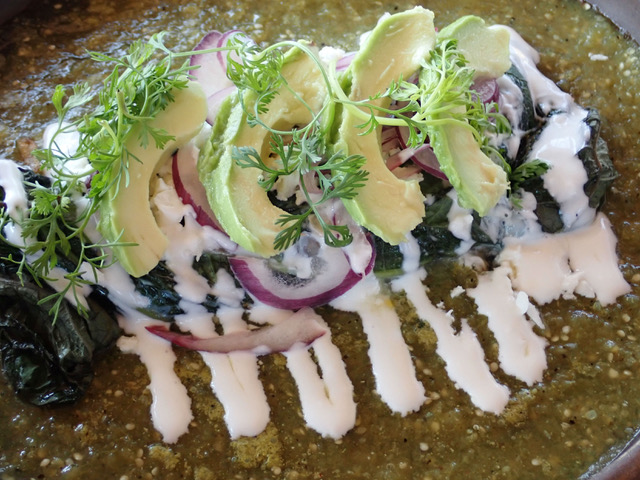
With its large windows, wooden floor, open brickwork and kitchen Milli has the vibe of a US West Coast coffeeshop. On the menu however are traditional dishes with a modern twist, all cooked with local ingredients. Heritage blue, red and white corn and heirloom bean varieties such as ayocote morado take centre stage. Each dish is beautifully presented and Instagrammable – and everything tastes as amazing as it looks.
The morning rush is over and Pérez has time to sit down and tell his story. He comes from Ozolco, a village in the mountains about 25km from Cholula. Among the 500 villagers quite a few have indigenous roots and still speak Nahuatl, the language of the Aztecs. At any given time, as many as a third of the population of Ozolco was working in the US illegally, says Pérez.
From Ozolco to Philadelphia and back
On October 5th 2009 Pérez left Ozolco together with his sister and his two-year old niece. With the help of ‘coyotes’, smugglers who, for huge fees, guide small groups of people through the desert and across the border into the US, he managed to reach Arizona three times before being caught and sent back to Mexico. The worst part was that by that point his little niece was already in the US. Because she was too small to cross with Pérez and her mum through the desert, another coyote had taken her with fake papers via a regular border crossing. “I’m not a child minder”, he told Pérez on the phone and handed the two-year old to a fellow Mexican to take her to Philadelphia. Luckily, the girl’s father was already there and able to pick her up.
On his third attempt Pérez made it to a trailer park in Arizona, where the group was to stay over night before starting the onward journey to their final destination in the US. The coyote ordered burgers for the group which turned out to be a huge mistake: someone at the fast food restaurant figured out that the order was way too big for a single trailer and called the police. The officers broke down the door of the trailer, arrested and deported everyone.
Pérez’ fourth attempt was successful, but each of the crossings was a harrowing experience. “We were usually about 20 in a group and you had to be really fit. You have to carry water for four days in the desert, and to avoid the border control agents the coyotes take you through the mountains at night. During the day you try to hide and sleep. One older man in our group just couldn’t keep up and we had to leave him. I have no idea what happened to him”. On November 2nd, a month after leaving Ozolco, Pérez and his sister finally arrived in Philadelphia.
Community and identity
In Philadelphia, the newcomers could rely on the help of those who had made the journey before them. “For a month someone from the Mexican community already there provides you with food and a place to sleep. You also get some money. After that time you are expected to have found work and earn a living”, says Pérez. Like many from Ozolco he got a job in a restaurant. He started as a dish washer, became a chef, and finally ran the whole kitchen. “We Mexican Nahuatl speakers were such a close knit community. We always knew what was going on at home, we celebrated when folks in the village did, birthdays, weddings, Day of the Dead, it was home away from home”. Living in Philadelphia made them realise how important their language is, their traditions, their food. “We developed a really strong sense of identity and community”, says Pérez who returned to Mexico after three years because “I just had enough of the American way of life”.
Back in Cholula he couldn’t find work. “I was expected to start out as a dish washer again”, says Pérez, “but life in Philadelphia had changed all of us. We had learnt so much, we had skills and we were proud of what we had achieved. We knew how to cook, how to present a dish in a high-end restaurant, many of us had worked front of house, others had prepared menus and were in charge of buying fresh produce, sourcing ingredients”. For Pérez and 15 of his former co-workers starting Milli was a way to build on the community that they had shaped in Philadelphia and make use of all the knowledge and skills they had acquired. And the food they cook and serve speaks of their identity: “We are from Ozolco, we want to live here, we want to live well. We want to keep our traditions alive, and through the food we cook we share them with others”.
[1] https://www.theguardian.com/uk-news/2026/mar/24/restaurants-raided-britain-version-ice-immigration
Marianne Landzettel is a journalist and author writing and blogging about food, farming and agricultural policies in the UK, the US, continental Europe and South Asia. She worked for the BBC World Service and German Public Radio for close to 30 years. Follow her on X at @M_Landzettel and Instagram @m.landzettel . Image used with kind consent of @M.Kunz
The Slow Food blog welcomes contributions on the topics of Food, Farming and Agriculture. The contents may not entirely match the views of Slow Food, but reflect the journeys of the authors. To write for us please click here


